Photorealistic visualisation in a real-world context
28 May 2026
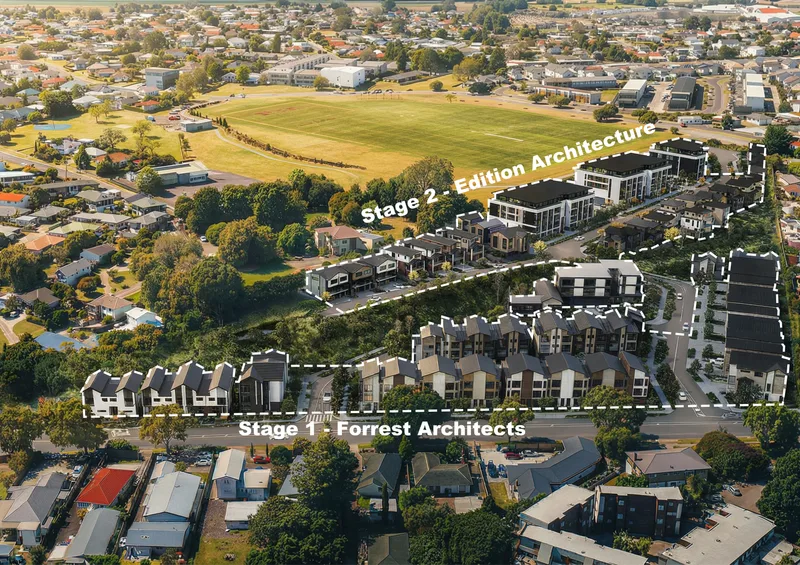
Edmonton Rise isn't a building — it's a whole neighbourhood: detached homes, terraces, apartments, a childcare centre and a café. Our job was to let people see it before it's built.
It starts on real ground. A drone mapped the actual site in Henderson, West Auckland and everything around it — the streets already there, Te Atatu South Park, the shops on Lincoln Road, the schools nearby — so we could show the homes in the context someone will actually live in, not floated on a blank backdrop.
Into that verified context we set every part of the plan — each building rendered through our in-house AI pipeline and caught at dusk with the interiors warm, photoreal to the point you look twice to be sure it isn't a photograph.
One community has to read as one place. We held the same light and the same materials from the masterplan down to a single doorway, so the whole mix hangs together instead of feeling like a folder of unrelated pictures.
Stills are only the start. We cut the images into a film, and built the development its own website — the plan, the homes, the points of interest around them — so a buyer can walk the streets and step inside on their phone, before a single pile is in the ground.
Drone, renders, film, website — all of it made in-house, and all of it holding one line: the picture has to tell the truth. Right sun, right neighbours, right scale. That's what separates a visualisation from a sales trick, and it's the discipline the whole thing rests on.
Why we build this in-house at all, and where a person stays in charge, is in Towards AI Integration.